

Moon Bases? Moon Bases.


Someone get Richard C. Hoagland on the phone! We're talkin' moon bases!
Tucked in time between the current Artemis moon missions and the 1960's Lunar Orbiter programs arose a golden era for lunar anomaly hunters. NASA's early close-up images inspired curious researchers to investigate the strange formations littering the moon's surface. As probes beamed back anomalous images appearing to show sprawling installations on the moon, accusations mounted that NASA was obscuring knowledge and altering evidence of these constructions.
In addition to visual irregularities, a handful of astronauts and contractors who took part in moon missions tell stories of a presence already established by the time we touched down. When various military studies highlighting government interest in the topic became declassified over the years, fringe theories and speculation about outposts on our moon began to develop. It wasn’t long before the accepted narrative about the “lifeless” rock orbiting Earth began to crater.
With Artemis III slated to plop humans back on the face of the moon in the near future, it’s time to revisit the history of bases, ruins, and artificial structures planted on our celestial neighbor.
Part 1: Men on the Moon (Covert Human Bases)
Before any Earth powers focused on developing the moon, they devised ways to destroy it. The U.S. and the Soviets both had similar aspirations about exploding a nuclear bomb on the far side. Project A119 was a U.S. Air Force project in 1958 that considered ways to achieve this objective. With the help of a budding young astrophysicist named Carl Sagan, the A119 asserted that detonating a nuclear warhead on the moon would be an impressive show of force and would visibly demonstrate America's superiority in space. The idea that the military was seriously considering a lunar nuclear assault would become a central component of later theories suggesting the rubblization of an extraterrestrial moon structure. While the study supposedly existed only on paper, it's worth noting that the lead of the project, Leonard Reiffel, later contributed at a high level on the Apollo Program as deputy director.

In order to control the moon, a permanent, physical presence was needed—or so was the thinking behind Project Horizon, an official proposal drafted by the Army Ballistic Missile Agency in June, 1959.
The study’s first two volumes consisted of over 400 pages detailing a method for reaching the moon with enough materials and crew to begin creating a base of interconnected tubes underground. According to the Army, (a decade before Apollo 11 officially put a man on the moon) their “most challenging and perhaps the most urgent objective [was] that of establishing a manned lunar outpost on the moon.” With stakes that high, it's easy to imagine that such an undertaking could have been completed by the 1970s.
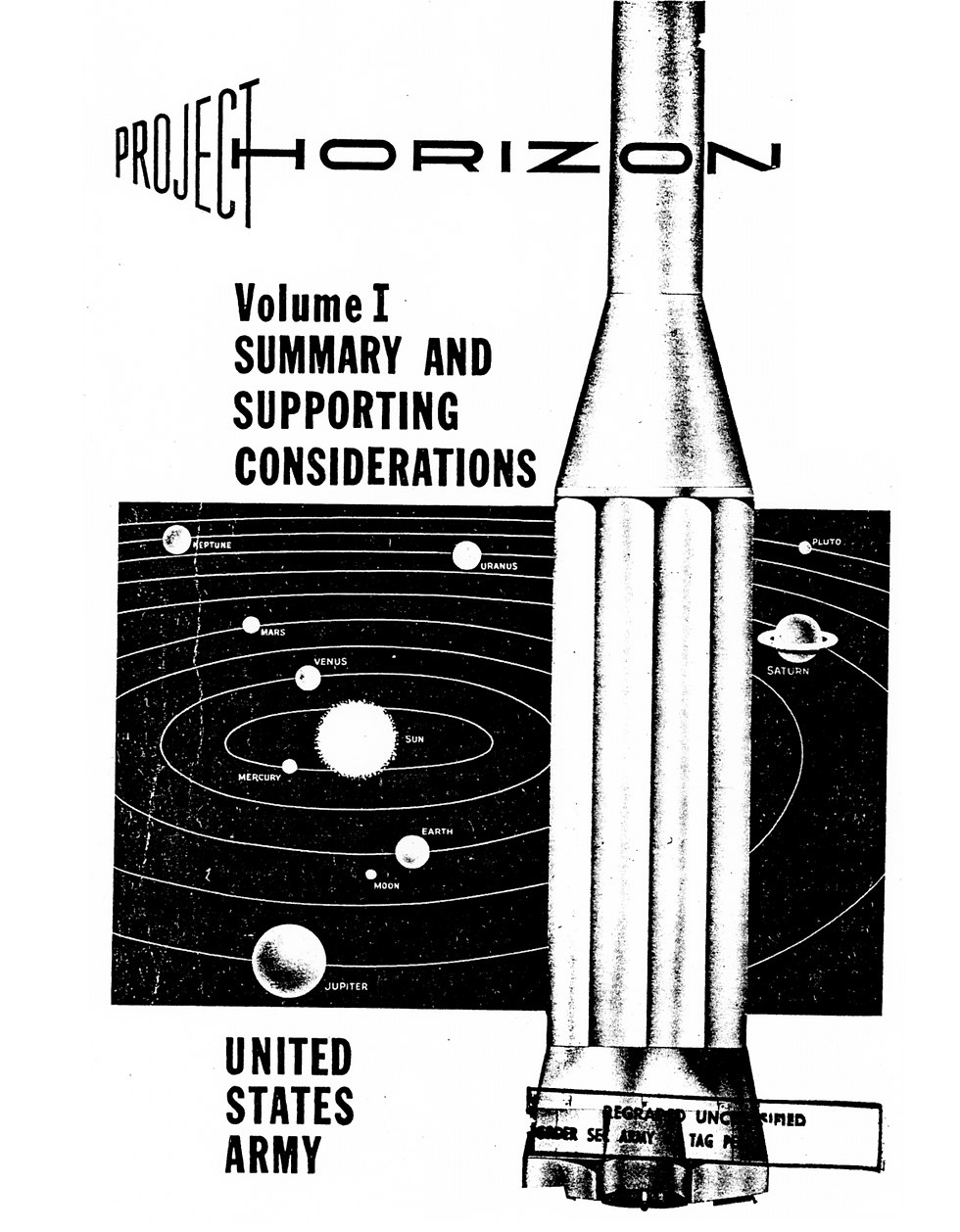
For those who argue that the technology for these lunar endeavors wasn't available at that time, the Army's own report estimated that the first landings on the surface by any nation would take place by 1964 (they transpired in 1966), with astronauts in tow by 1965 (they tagged along in 1969). Clearly, the brains behind the Horizon proposal weren't far off regarding the progression of space technologies. The report went on to say that establishing a manned lunar outpost by the end of 1966 would require “no major breakthroughs” in technology, plainly stating that “[t]he establishment of a lunar outpost is considered to be technically and economically feasible.”
Curiously, a sparsely circulated and hard to locate Volume 3 of the Army's Project Horizon proposal also detailed the weapons they recommended astronauts pack: pistols, claymore explosives, grenade launchers, and an atomic missile. This is an impressive arsenal to bring to an "uninhabited" destination.

Not to be outdone by their military counterparts, the U.S. Air Force commissioned their own feasibility study explaining how they would get to the moon and back. The 1961 report included the creation of a multi-person, subsurface moon base to be constructed by 1968. Their plan, blatantly named Lunar Expedition (Lunex), was outlined in a 198-page document that concluded “it is technically and economically feasible to build a manned lunar facility.”

The level of detailed consideration given to installing moon settlements is indicative of the degree of earnestness that military and government officials placed on such a mission. Not only were there political, psychological, and national defense benefits to claiming lunar real estate, there were also potential resources, advantages in global communication, and an unparalleled edge in deep space travel to gain. Using the far side of the moon as a launching station for further space exploration was among the top priorities of both proposals.
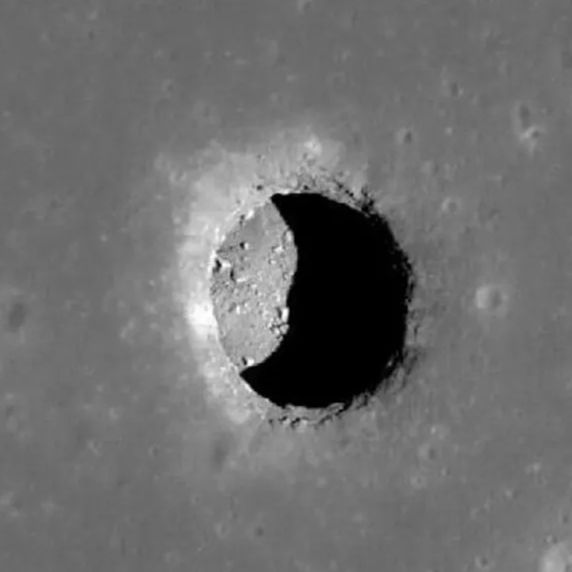
Most proposed lunar stations leveraged the moon's topography. Project Horizon's outpost sought protection from extreme temperature fluctuations and incoming meteorites by hiding bases within holes, caves, or underground.

Lunex put forth a “facility designed to be constructed under the lunar surface.” Indeed, many of the suspicious moon terminals seen in photographs appear to be built into the side of existing rock formations, craters, or canyon walls. This "artificial architecture" often looks as if it were covered with a layer of lunar soil after construction. This natural method of insulation is consistent with techniques suggested across various public and private proposals, implying that the potentially engineered complexes glimpsed in images are compatible with modern building techniques.

Further clues that the United States saw moon bases as a top priority come from Vice President Hubert Humphrey. His remarks entered on the Congressional Record in 1966 reveal his sincerity concerning the topic. Without fixing a specific timeline, he expressed his vision of “the exploration of the lunar surface, and possibly the establishment of one or more permanent bases there.”
Humphrey’s comments came amid Soviet plots involving the creation of permanent lunar basecamps. Their own N1 Program had an explicit goal in the early 1960s: “establishment of a lunar base.” As part of their mission, the long term installation known both as the DLB Lunar Base or Zvezda was planned from a series of connected pods protected under a layer of lunar regolith. This would provide a headquarters from which to further explore the mysteries of space and solidify Soviet dominance in a new sphere of combat. Boris Chertok, Deputy Chief Designer of the Soviet Space Program during that time, wrote in his autobiography that the Russians could “gain prestigious ‘revenge’ by creating a permanent lunar base by the end of the 1970s,” and was convinced that “it really would have been possible to achieve this.”
A 1961 issue of the USSR's Military Thought (a publication they deemed ‘Top Secret’) expounded upon what the Soviet’s knew at the time about America’s lunar ambitions. The author of the report was impressed by “the potentialities that unfold with the employment of lunar bases.” The Russians seemed convinced that their Cold War enemy had “[s]pecific projects … being worked out which propose the construction of various structures under the surface of the moon.”
In a classic show of Cold War paranoia, the U.S. was speculating about the Red Army’s lunar aspirations in a similar manner. It was the CIA’s official estimation in 1965 that a Soviet “lunar landing may be followed fairly rapidly by the establishment of a Soviet base on the moon.” Subsequent Russian moon base concepts sprouted up throughout the 1970s with the revelation of the Lunar Expeditionary Complex (LEK), among others. These projects helped keep the idea of manned lunar structures alive in the public consciousness.

In a precursor to modern-day podcasts, Dr. Peter Beter (appointed by President John F. Kennedy as general counsel for the Export-Import Bank, 1961-1967) recorded and distributed his "Audioletters" containing monthly news reports concerning Rockefeller sponsored government conspiracies and other unscrupulous plots to control the world. In Audioletter 26 from 1977, Dr. Beter revealed what he knew about the covert moon base erected by the Rockefeller’s and their puppet regime.
As the story goes, from a restricted military base in a remote area of the Indian Ocean (one of America’s largest overseas bases: Diego Garcia Island), this secret space program successfully created the “perfect moon-port … from which secret missions to the moon have been launched during the building of the moon base.” The project culminated in the construction of a settlement within the moon’s Copernicus Crater, a strategic location from which to install weapons that would solidify America’s (and by extension, the Rockefeller’s) total domination back on earth. Yet the tables were eventually turned on the Americans. In what would become known as the Battle of the Harvest Moon, Beter explains how the Soviets were able to demolish the U.S. lunar station in 1977 by employing a new weapon called the “Neutron Particle Beam.”
Wikileaks unearthed an official document that adds a dash of credibility to Dr. Beter's conjectures. The Congressional Correspondence sent to Rep. Samuel Devine in 1979 from the Department of State’s Bureau of European and Eurasian Affairs is short on substance. Its title, however, leaves little to the imagination: “REPORT THAT UR (SOVIETS) DESTROYED SECRET US BASE ON MOON.” The message does not give any further details about the context or contents, but the subject line suggests that if the United States did achieve a base on the Moon, the Soviets found a way to neutralize it.
More recently, NASA has released the Artemis Accords, which define how the U.S. will approach the moon, space, and the reclamation of its resources in the coming decades. The Trump administration's Executive Order 13914 helped to clarify their stance about whether the U.S. and its private enterprises were subject to a 1979 “Moon Agreement,” which held that the moon and its harvested resources should be regulated by an “international regime” in league with the United Nations. Section Two of the President’s executive order clears up any misconceptions about the country’s participation, stating explicitly: “The United States is not a party to the Moon Agreement.” These developments imply that our “dead” Moon in fact does contain valuable resources worth mining—knowledge that may have served as motivation for the creation of bases and mining operations in the past.
As the paper trail left behind beginning in the 1950s is collected and pieced together, it becomes easier to imagine the existence of human constructed lunar bases. Multiple official documents indisputably reveal that government desire was sizable; and the technical barriers they faced were decidedly limited more than 50 years ago when plans were first put forth. Yet regardless of how seriously human space agencies pursued their initiatives, many lunar anomaly researchers and fringe theorists see something decidedly more ancient and other-worldly in the perceived ruins and artifacts littered among the Moon’s craters.


Comments