

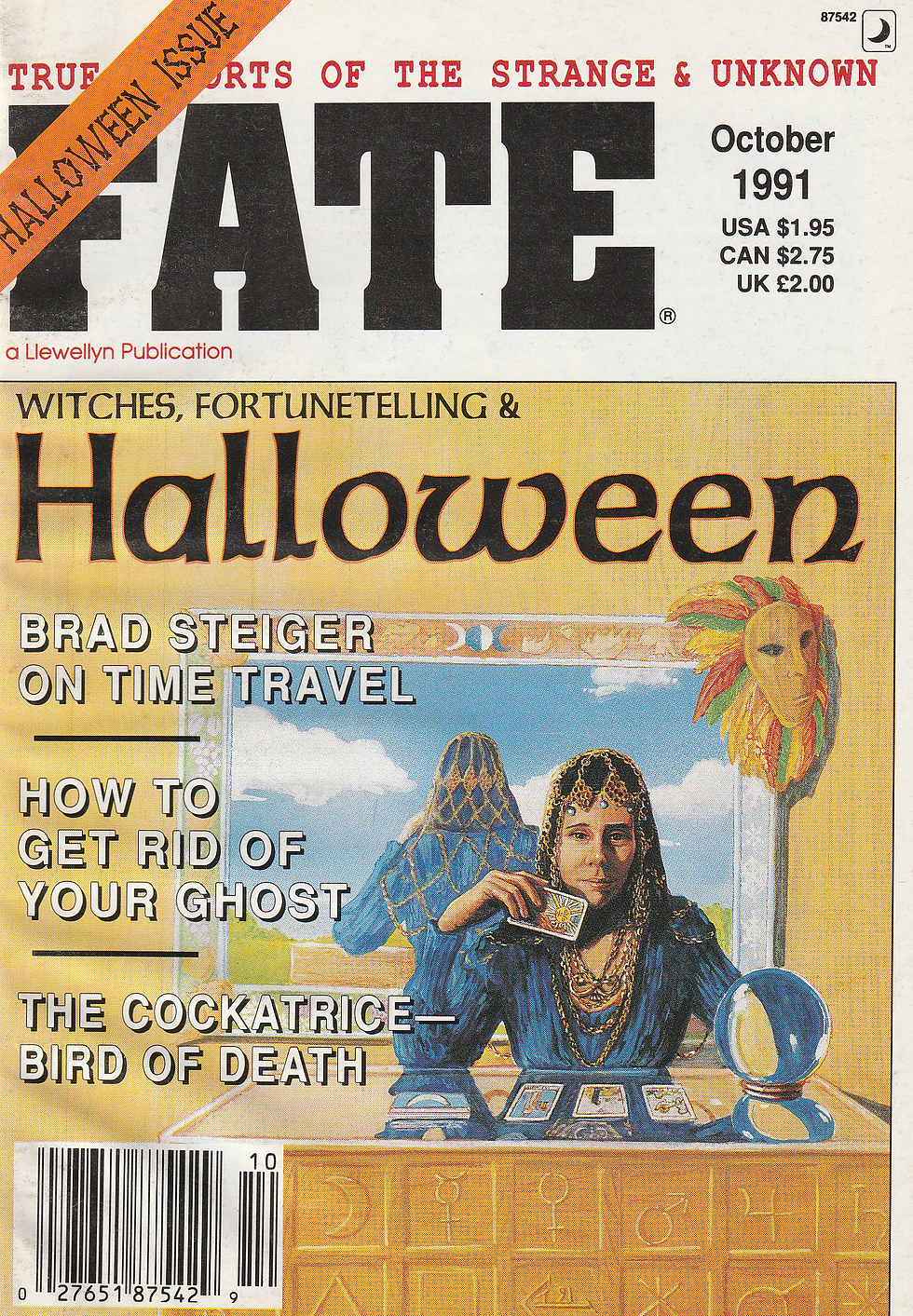
Witches, Fortune Telling & Halloween

For thousands of years, this night has been seen as a special night for contacting loved ones and foretelling the future. Here’s why.

by Pauline Campanelli (FATE, October 1991)
As the October sun sets and the jack-o-lanterns are lit on window sills and porches, costumed children everywhere gather for parties because it is Halloween–the night of Witches, goblins and trick or treat.
Among the traditional games that will be played–bobbing for apples, Pin the Tail on the Donkey and Spin the Bottle—there will probably be some kind of fortunetelling. Halloween, Witches and divination just naturally seem to go together, and there is a good reason for this.
To the pre-Christian Pagans of Western Europe, Halloween or Samhain (pronounced sow-wen), as it was called in Celtic countries, was the equivalent of New Year’s Eve. It marked the end of the old agricultural year and the beginning of a new one. It was also the celebration of the final harvest before the long dark months of winter. With such uncertain times ahead, our Pagan ancestors naturally used whatever means they knew of to foretell the future.
Divination was so closely related with the Pagan, pre-Christian religions of Western Europe (including what is today called Wicca or Witchcraft) that the early Church, in an attempt to eradicate the Old Religion, forbade soothsaying in every variation. In England such prohibitions were evident in laws as early as the Anglo-Saxon period.
Later they were found in such laws as the Homilies of Wulfstan and Aelfric, the Canons of Edgar, and the laws of the Northumbrian priests (ca. 1028) and others, long before the infamous Witchcraft Acts of Henry VIII (ca.1542) and Elizabeth I (ca. 1563).
These laws reflected similar laws on the Continent. By the time of the persecutions—known politely as the Witch Trials after James I ascended the throne in 1604—the charges of divination, sortilege or necromancy were frequently among the accusations made against Witches that inevitably led to death by hanging (burning was the traditional method of execution on the Continent).
Fragments of the Old Religion survived, and today an ever increasing number of people are practicing a religion called Wicca, based on these ancient beliefs and traditions. As modern-day Witches or Wiccans cast their magic circles to celebrate the Samhain Sabbat (forerunner of the Halloween party) some form of divination, sortilege, or necromancy is usually practiced.
But whether you are a modern-day Witch or just enjoy the fun of this ancient holiday, here are some traditional ways of looking into the future.
SORTILEGE
Sortilege means the drawing of lots for the purpose of divination. A lot might be any object that could be drawn from or put into a container and tossed. Early forms of dice were used in this way. Runes and Tarot cards also would be included as types of sortilege. The cards or symbols are chosen by random chance. Tarot cards, runes and similar means of divination require the knowledge of a system of symbols and their meanings often both on a mundane divinatory level and a more esoteric level as well.
There are other methods of divination by random chance that are very simple. One method used by young women to learn the identity of their future husband was to name one hazelnut for each boy they knew, then roast them all together by an open fire. The name of the first hazelnut to jump or pop was the name of the boy she would marry. This method of divination can be applied to any question having multiple answers, or even a simple yes or no.
Hazelnut trees are closely associated with divination. Their wood is traditionally used for
divining rods, for water witching, or locating water or other re sources by dowsing. Hazelnuts are also ready to harvest at Halloween. Another fruit of the season is the apple, and it too was used to divine the identity of one's future partner. The apple was cut into nine equal parts. Eight of them were eaten and the ninth was tossed over the left shoulder. Then, by quickly turning around, the young person would catch a glimpse of his or future mate. (Technically, this is scrying. More on scrying later.)
In more recent times a variety of games and objects for predicting the future on Halloween night have been produced. These include Wheel of Fortune-type games where a number is selected by random chance leading to a predetermined set of predictions that correspond to the numbers. In another version little charms were baked into cakes which later were sliced and served at random. No doubt many a child has swallowed his fortune by this method!
SCRYING
Along with divination and sortilege, the Synod of Exeter in 1287 condemned conjuration “by means of sword and basin” as dishonorable to God. By “sword and basin” or “blade and bowl” refers to scrying, or mirror magic.
To people who have developed the ability to scry, images of the future may appear in a mirror, a bowl of water, a crystal ball or the polished blade of a sword.
The term “by sword and basin” is a very interesting choice of words, and very meaningful to a contemporary Witch. There is a part of almost every Wiccan ceremony when the point of the magical knife is placed in a cup (bowl or cauldron) of wine expressing the union of opposites or male and female polarities. The term “by sword and basin” expresses one of the fundamental beliefs of Witchcraft.
It is believed by many that in order to scry the mind must be free of hopes or fears, delusions or preconceived ideas of any kind. For this reason wizards and magicians sometimes used a young child to do their scrying for them. Regardless of who did the scrying, there are numerous objects that have been traditionally used for the purpose. Here are a few of them:
The crystal ball of the Gypsy Witch is probably the most familiar, but the method of using it is not. It is simply to gaze into the ball while cradling it in both hands in a piece of black velvet or other non-glossy fabric.
The cauldron is one object that is frequently associated with Witches and it is also used for scrying. A cauldron is generally a three-legged, black, iron vessel with a neck somewhat narrower than its widest part. The method was simply to fill the cauldron with clear, fresh water and gaze into it. It sounds simple enough, but it is an acquired skill. To facilitate the matter, a bright, silver coin is sometimes dropped into the cauldron to act as a focal point. To Wiccans, the cauldron is associated with the Goddess and is a symbol of rebirth.
Another early and traditional object that recreates the seemingly boundless depths of the water-filled cauldron is the black mirror, or Witch’s mirror. This is made by holding a small, earthenware bowl inverted over the flame of a candle until the interior of the bowl is entirely covered with soot. Then the bowl is gently filled with pure, fresh water.
(Throughout Europe there are many springs and wells that were considered sacred by ancient people. Among these springs and wells are many that are associated with prophecy. Water from such a well would be ideal for the cauldron or black mirror.) Then the black mirror is gazed into as it is held in the palms of the hands. This method was known to the ancient Greeks who would foretell the future of anyone whose reflection was cast onto the water’s surface.
A scrying mirror need not be a black mirror. An ordinary looking glass will do very well. Some of the earliest mirrors were discs of polished copper or bronze.
The mirror and the comb are symbols of the Goddess in Her aspect as Goddess of Love and Beauty. To gaze into a looking glass is to gaze into one’s own reflection. This requires subdued lighting—candles are ideal—and the proper frame of mind. The association of the comb with the mirror might be very important. I have frequently had glimpses of events that were to occur later the same day while absentmindedly gazing into the bathroom mirror and brushing my hair.
Perhaps the act of combing one’s hair generates other kinds of energy than just static electricity.
In any case, mirrors that are used for scrying are traditionally not used for any other purpose.
Large or wall mirrors are kept draped, and hand mirrors are kept hidden away or face down.
Many Witches also periodically wash the mirror or the crystal ball with an infusion of mugwort, an herb that stimulates psychic activity. This might be done on each Full Moon, and the mirror or crystal can be left to stand overnight in the magical moon-light. The Moon itself is a mirror in the sense that it reflects the Sun, and by reflecting one mirror in another one can theoretically see into infinity in both directions. Perhaps this is one reason that the looking glass is also sometimes used to look into previous lives.
The key word for all forms of scrying is gaze. This means to throw the eyes slightly out of focus by looking through or beyond the object at which you are gazing. At the same time it is also necessary to achieve a very relaxed, meditative state.

NECROMANCY
To most Wiccans and Pagans the night of Halloween marks the midpoint between the Autumnal Equinox when day and night are equal, and Yule, or the Winter Solstice, the longest night of the year. It is the center point of the darkening time of the year which is always associated with the spiritual rather than the physical side of life. For this reason Halloween is considered the night when what Witches call the veil between the worlds (of spirit and matter) is very thin, and the spirits of the deceased are very close.
This makes communication with them a little easier than at other times. Though most Witches considered it immoral to disturb the dead who are in that lovely place of refreshment and renewal they, like Spiritualists, call Summer-land, it is always hoped that one of our loved ones or ancestors will take advantage of the opportunity offered by the magic of this night.
In order to facilitate their communication there are several devices that might be used. The first is the infamous Ouija board.
This innocent object has gathered about it such an aura of fear and evil that I hesitate to recommend it. The Ouija board is simply a board with an alphabet and numbers from 0 through 9, and the words "yes," "no" and "good-bye" printed on it. A pointer called a planchette (which is now usually made of plastic is placed on the board and the participants each place a fingertip or two lightly on around an inverted wine glass.
The champagne type is the most desirable type because it is least likely to tip and break. Each participant places a fingertip or two on the upturned base of the wine glass and the traditional question is asked. If dates or other figures are being discussed, numbers may be arranged within the circle of letters. The wine glass used by my husband Dan and I is the sole survivor of a set of Swedish crystal champagne glasses. Our letters are drawn in a Gothic style on heavy illustration paper.
These two methods of receiving spirit communication may have had their origins among the ancient Etruscans. There, in pre-Roman Italy, a hen would be placed in the center of a circle that was divided into segments. Each segment contained a letter of the Etruscan alphabet and some grain.
As the hen pecked at grain, prophetic messages were spelled out.
A third device is a pendulum board. In this case letters are arranged on half of a circle and lines are drawn from the center of the circle to a point between each letter. A pendulum is held over the center point of the circle and messages are spelled out by the pendulum swinging from one letter to another. This method can only be used by an individual. A pendulum may be any weight at the end of a length or string, but if you like working with a pendulum, a little effort in finding or making one will be rewarded. A crystal or birthstone suspended on an appropriately-colored thread is traditional.
Strictly speaking, necromancy is communicating with the spirits of the dead for the purpose of divining the future, but on the night of Halloween any message from a loved one who has passed on is welcome, and communication with the dead is not considered immoral as long as the spirits communicate voluntarily.
It is the hope of some living Witches to make contact with the spirits of Witches on the other side—not for the purpose of learning about the future but to learn about the past and perhaps to glean a bit of ancient wisdom.
The Devil and demons are not articles of the Wiccan faith and so the Witch does not fear to make contact with the spirit world. Still we are aware that there are some negative entities “over there” that might be all too eager to come through. For this reason any device such as a Ouija board should be ritually cleansed before use, especially if it is to be used in the Witches' circle where great amounts of psychic energy may be generated. (This cleansing need not be done every time the device is used; just prior to the first time.)
Here is a simple purification ritual. Hold the object in the smoke of wormwood (available at some herb shops or metaphysical supply stores) saying words like: I purge you in this smoke so that all evil influences be cast out.
Then sprinkle it with water that has salt in it saying something like: I anoint thee that thou may be a vessel of good intent.
Then hold it above a candle flame saying: I declare this board a vehicle of spirit communication.
PURIFYING YOUR AREA
At Halloween, Witches would be using such a device within a circle that has already been purified and consecrated. Friendly spirits and the spirits of loved ones and ancestors would have been ritually invited into the circle. If you are not Wiccan you might want to do a simple banishing ritual before beginning.
Light an indigo or violet candle (colors believed to be attractive to the higher spiritual planes). Walk around the area in a clockwise direction with a censer burning a small amount of wormwood or sprinkle spring water about the area by dipping sprigs of rosemary, wormwood or vervain in it, saying words like: By the power of this smoke and/or herb I order ye unfriendly influences Be gone!
After you have done this, sit quietly for a few minutes. Breathe rhythmically to achieve a relaxed or meditative state—then begin.
OTHER METHODS OF DIVINATION
The methods discussed here are by no means the only ones used in ages past to predict the future. There are countless others, and the kinds of materials used are even more varied. There is lithomancy which uses stones, tea leaves, bones, the flight of birds, the drippings of molten wax or lead, etc. The methods mentioned here are just the ones most commonly associated with Halloween or mentioned in the Witch trials.
Whatever the method or material used, the important thing to remember is that no matter what is revealed regarding the future, nothing is carved in stone. The future is not inevitable. We create our own future with every choice that we make today
And so, as the magical night of Halloween approaches, keep in mind the words of an antique card postmarked 1920:
May Halloween frolics engage you tonight
and your future by Witches predicted be bright!


Comments